


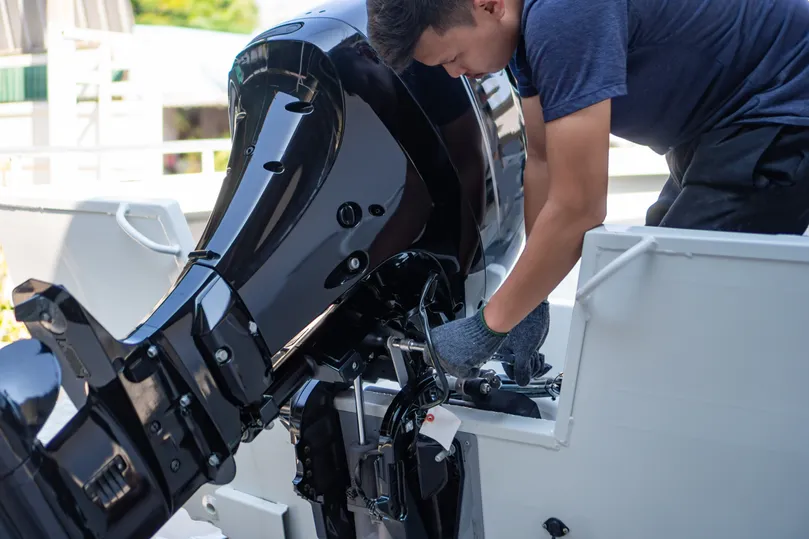
Before You Buy a Used Boat
Hours and paperwork tell you more about a used boat than a test ride does. Here is what to pull, what to verify and which numbers determine whether any coverage comes with it.
A used boat looks its best on the day it is listed. The things that determine what it will cost you over the next three years are not visible in photos, and most of them are in the engine's history rather than its appearance.
Here is what to check, roughly in the order we would check it.
1. Get the Actual Hours, Not the Stated Hours
Start with the display, but do not stop there. On a Volvo Penta, the electronic engine control module records hours of use and they cannot be reset, and an authorized Volvo Penta dealer can pull the actual recorded usage with factory tools. Mercury and Yamaha engines similarly store data a dealer can read.
If a seller's stated hours and the module disagree, you have learned something important about the seller.
2. Work Out What the Hours Mean for Coverage
This is where the brand matters enormously.
On a Volvo Penta gas engine or sterndrive, coverage is capped by hours. Gas Factory Protection runs three years or 480 hours, whichever comes first. A three-year-old boat with 400 hours has far less coverage remaining than a three-year-old boat with 90, even though both look the same on paper.
On a Yamaha, coverage runs on the calendar with no hour cap, so what you need is the registration date rather than the hour meter.
On a Mercury, check the coverage chart for the model, and note that product is excluded from warranty six years after its date of manufacture regardless of when it was sold.
3. Ask for the Service Records Before You Negotiate
Not after. The records are a negotiating input, and their absence is one too.
You are looking for continuity, not volume. A boat with a break-in service, then annual services in sequence, from a dealer authorized for that brand, is a boat that has been maintained. A boat with two receipts from four years ago is not, whatever the seller says.
On a Volvo Penta this is not optional if you want the remaining coverage. The documentation requires written proof of maintenance to the prescribed schedule for program benefits, and it is the seller's responsibility to pass those records to you. No records means no usable coverage even if the term has not expired.
4. Confirm the Transfer Is Actually Possible
Every brand has a window and some have eligibility rules.
Yamaha requires a dealer inspection and a change of registration submitted within ten days of the transfer. Mercury Product Protection transfers within 30 business days of the sale date with a form, a bill of sale showing the serial number and a fee. Mercury also states that engines not purchased directly from another pleasure-use owner or an authorized dealer are ineligible, and reserves the right to refuse transfers on repossessed, auction, salvage, liquidator or insurance company product.
If the boat you are looking at came through an auction, ask about this before anything else.
5. Get a Pre-Purchase Inspection
You will likely need a dealer inspection for a Yamaha transfer anyway, so this is not an extra step so much as an earlier one.
What an inspection catches that a test ride does not: gear lube condition, which reveals water intrusion and internal wear. Compression across cylinders. Stored fault codes, which are a written history of what the boat has actually been doing. Anode consumption, which hints at how the boat was kept. Bellows and seals on a sterndrive. Corrosion under the cowl and behind the trim.
6. The Questions Worth Asking the Seller
- Was it stored in the water or on a trailer, and where?
- Was it professionally winterized every year, and can you show that?
- What fuel did it run, and was ethanol-free used?
- Has it ever had a warranty claim, and what for?
- Is the engine currently registered, and in whose name?
The last one matters more than it sounds. An engine that was never registered by the original dealer may have had no coverage running at all.
We Will Check It for You
We perform pre-purchase inspections on boats regardless of where you are buying them, and we can pull recorded hours, fault history and remaining coverage for Yamaha, Mercury and Volvo Penta. Call the service department before you write the check.
What the Manufacturer Documentation Says
Manufacturer Sources
- Volvo Penta North America Gas Factory Protection. Volvo Penta
- Mercury limited warranty and Product Protection transfer. Mercury Marine
- Yamaha Owner Resources FAQ. Yamaha Outboards
Coverage terms, exclusions and service intervals vary by model, model year and how the boat is used, and manufacturers revise them. This article is a general guide, not a statement of your coverage. Confirm the details for your engine against your own documentation and serial number, or call our service department and we will pull them for you. Information current as of the date shown.
Let Us Pull the Schedule for Your Engine
Service intervals vary by model and model year. Give us your serial number and we will tell you exactly what is due, what it covers and what it costs before you commit.