


E10 Is Your Ceiling, and One Bad Fill Can End Your Coverage
More of the repair work we do traces back to fuel than to any other single cause. Here is what the manufacturers permit, what they exclude and how to store fuel through a Texas winter.
If we had to name the single largest source of avoidable repair work in our shop, it would be fuel. Not abuse, not hard running, not age. Fuel.
E10 Is the Ceiling
All current Mercury gasoline engines are designed to operate safely on fuel with a maximum of 10 percent ethanol. Mercury's own guidance is direct about why: the metal, rubber and plastic components in the engine and fuel system are not designed to tolerate the corrosive effects of a higher blend. Where it is available, Mercury recommends gasoline with no ethanol at all.
Above 10 percent, the consequences are not just mechanical. Mercury states that warranty coverage on a broad range of repairs and services becomes void on any Mercury engine operated on fuel with an ethanol content above 10 percent. Volvo Penta's exclusions cover fuel contamination and use of fuel not specified in the operator's manual. Yamaha's manuals likewise specify an E10 maximum.
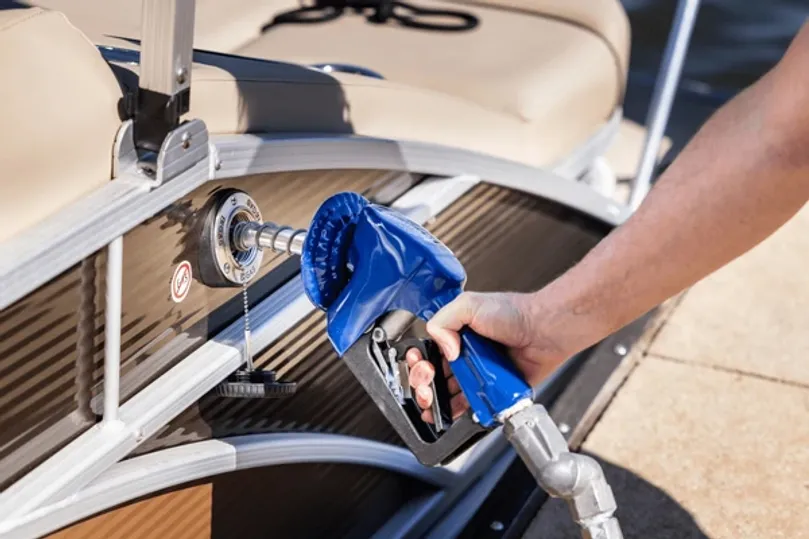
E15 is prohibited for use in recreational vessels and it is at pumps across Texas. E85 is worse. Both are labeled, but the labels are small and easy to miss when you are filling jugs at a road station rather than a marine dock.
How bad is it? A 2011 high-ethanol endurance study run on three Mercury outboards resulted in the complete failure of a Verado 300. That is the documented outcome, not a worst-case scenario.
It is also not just the engine. The entire fuel system in the boat, from fill hose to tank to fuel line, was designed around E10 tolerance.
Why Ethanol Causes the Damage It Does
Three mechanisms, and they compound.
It attracts water. Ethanol is hygroscopic. It pulls moisture out of the air in your tank, particularly through a vent, particularly through the daily temperature swings we get. Enough water and the ethanol and water separate out and settle to the bottom of the tank, which is exactly where your pickup is.
It acts as a solvent. On older boats especially, ethanol strips varnish, resin and deposits out of tanks and lines and delivers them to your filters and injectors.
It degrades in storage. Ethanol-blended fuel has a short shelf life. Left through a winter untreated it oxidizes and leaves gum and varnish in the injectors, the rails and the carburetor on older engines.
Storing Fuel Through a Texas Winter
The advice that works here:
Treat the fuel, then run it.
Stabilizer in the tank does nothing for the injectors. Add it, then run the engine long enough to draw the treated fuel all the way through the system.
Do not leave the tank half full.
The empty space above the fuel breathes as temperatures swing and brings moisture in with it. Manufacturer guidance generally favors filling to near capacity, leaving room for expansion, rather than storing partially full.
Service the fuel-water separator before storage, not after.
Anything the separator has already caught should not sit in there all winter.
Buy fresh fuel late in the season.
Fuel that goes into storage should be as new as possible.
Ethanol-Free Fuel
It is available in North Texas at marine fuel docks and select stations, and it costs more. For a boat that sits between outings and through winter, the premium is generally worth it, and Mercury recommends no-ethanol fuel where you can get it. If you use ethanol-free fuel during the season and it is what goes into storage, most of the problems above simply do not arise.
What to Do if You Think You Misfueled
Do not run it. Call us. Draining a tank is inconvenient and inexpensive compared to a fuel system rebuild, and it is a great deal cheaper than a powerhead.
What the Manufacturer Documentation Says
Manufacturer Sources
- Mercury Marine fuel basics. Mercury Marine
- Mercury Marine on E15 at the pump. Mercury Marine
- Volvo Penta North America Gas Factory Protection exclusions. Volvo Penta
Coverage terms, exclusions and service intervals vary by model, model year and how the boat is used, and manufacturers revise them. This article is a general guide, not a statement of your coverage. Confirm the details for your engine against your own documentation and serial number, or call our service department and we will pull them for you. Information current as of the date shown.
Let Us Pull the Schedule for Your Engine
Service intervals vary by model and model year. Give us your serial number and we will tell you exactly what is due, what it covers and what it costs before you commit.